Monday, August 5, 2013

Final stop in India: Varanasi

So here's the spoiler: we survived India (occasionally against the odds). We arrived at our last Indian destination, Varanasi, by sleeper-train. It seems that we had run out of good luck with sleeper trains with our journey to Agra, because this time we were allocated two upper bunks, with my bed being above India's Champion Snorer. It was not just the volume of his snoring that won him that prestigious title and prevented us from sleeping; so strange and varied were the animal-like gutteral noises he produced that I couldn't go to sleep for fear that I would miss his most impressive sound yet.

It's fair to say that I found the idea of Varanasi a little intimidating. It's a place where Hindus go to die and to cremate their departed relatives, and a place which every single traveller we met who had been there described as “intense”. As with Delhi and Agra before it, expecting the worst actually resulted in a pleasant surprise upon arrival. Varanasi isn't the nicest place we have visited on this trip by a long shot, but we didn't receive the barrage of attention from rickshaw drivers, guesthouse operators etc that we had been warned about, and we found a decent guesthouse without a problem.

The main focus of Varanasi is the famous Ganges where millions of Hindus go each year for holy dips and blessings at the various ghats, and also where the deceased are publicly cremated. We were expecting to spend a lot of our time in Varanasi wandering around the various ghats watching the goings on and soaking up the atmosphere (and perhaps seeing some unpleasant sights in the process). Well, have I mentioned that it is the rainy season at the moment? Well it is, and as a result the Ganges is so high that it is impossible to walk around the ghats; the only way to access any of the ghats by foot is to navigate the maze-like alleyways in the river-side area and try to find an alleyway that leads to the river. This could have been good fun – you never really know what you're going to see around the next corner when you walk around areas like that - however, it being the rainy season, it was raining! This made the alleyways more like tributories than pathways. Consequently, our idea of discovering the ghats for ourselves was scuppered.

On our first evening we walked down to the Ganges to see the fire puja ceremony. The ceremony was really interesting – a group of Hindu men slowly moving various flaming holy objects whilst music played (I know, I really haven't done it justice with that description) The downside, however, was that it is a huge tourist trap, with a significant part of the large audience being westerners (including many who had paid to get a good view from boats on the river and the balconies of the overlooking buildings). Along with that comes the inevitable opportunists looking to take advantage, and on a number of occasions I felt my pockets being tapped by very young children who are clearly part of a pick-pocketing racket which also involves adults (presumably their parents). The ceremony is a really impressive spectacle and it was clear that for many of the Hindus in attendance it was an important and holy experience; however, as a result of the large non-Hindu audience and being a little on-edge, for me personally it felt a little more like a show for the tourists than something sacred.


The alternative option for visiting the ghats at this time of year is to view them by way of an early morning boat tour. So we got up at 4.30am (for the second time in three days) the following day and made our way to the river where we were able to join forces with three other tourists and negotiated a not-too-outrageous price for a boat tour. Once again our early rise was rewarded; the river was absolutely beautiful as the sun rose over the far bank, and our non-motorised boat was really peaceful.


For the first part of the tour we were travelling upstream and it's fair to say that our rower earned his money as the bloated river was really powerful. 

He was working much harder than it appears in this pic
We passed by a number of ghats where people were taking early morning dips, some praying, some receiving blessings, some washing themselves and some washing clothes. The atmosphere was really pleasant and relaxed, and with a combination of the low light and peacefulness at that time of day the Ganges really does have an air of something sacred about it, something that I was not really expecting to feel.


Also unexpected were the interesting pieces of street art along the river bank. I'm not sure how in keeping graffiti is with such a holy place, but it certainly created an interesting juxtaposition.


After a post-boat tour nap (is it still a nap if it takes place at 7am?) we made another attempt to see the ghats on foot, and in particular the ghat most popular for cremations.  However, by that time the roads leading up to the ghat area were grid-locked as a result of being 6 inches deep in water and despite the attempts of traffic police on stilts wearing florescent waterproofs to organise the chaos.  We waded through the calf-deep water (making a conscious effort to not look at what was floating in it) but unsurprisingly the ghats were inaccessible.  Consequently we decided that our time in Varanasi would be short and that we would head north to Nepal the following day.

Varanasi was far from my favourite place in India, but it was also more pleasant than some others would have you believe, and it is certainly interesting to visit anywhere so revered by the people of a particular religion. It was also fitting, as it is the end of the line for many Hindus, that it should also be our last stop on our India rollercoaster.

So that is India done. Well, about as much of India as one can realistically see in 3 months disrupted by a bout of dengue fever and without spending more time in transit than stationary. I dare say that we will make some attempt to sum India up in a more succinct way when we have had time to recover and reflect, however it really isn't somewhere that is suited to a succinct summary and there are a million and one additional things that we could have written about the country if we had the time (and if we thought anyone else would read it all) but none can really do it justice.

Friday, August 2, 2013

All about the Taj

Spoiler:  we made it there!

Agra, home to one of the most iconic monuments in the world and, as we would soon find out, approximately 90% of the world's fly population. In honesty, our expectations for Agra were very low. The general buzz from other travelers seemed to be, “Yes, yes, see the Taj. Definitely. Then get the hell out. As soon as you can.” So with that in mind, we allocated one night for the 'Taj' before a mad dash to Varanasi and across the Indian/Nepalese border.

We arrived by a 2nd class AC sleeper train from Udaipur, which was our most delightful train experience by several miles (or would that be kilometers?). A private cabin, lovely cool air, a surprising lack of “chai chai chai” vendors coming around during the wee hours. We were absolutely delighted to say the least. So after a dozen hours or so on the train, we floated out of our private cabin on a beautiful soap bubble, which instantly burst upon our arrival. After we navigated a swarm of pests (no, not flies, rickshaw drivers) and some dubious pricing at the fixed price rickshaw booth, we headed into town with a driver we liked reasonably well. (He flatly told a group of drivers to stop bothering us.) So we decided to look at a guesthouse he recommended. Even with his commission, it was substantially cheaper than our first choice, and I'm not entirely certain we sacrificed much on quality.

Getting a decent driver can really make or break your experience, so often it's worth paying a bit more for somebody who is reasonably honest. With that in mind, we decided to hire him to assist us with planning our exit from Agra and a trip to see the Taj from across the river. From the rooftop of our hotel, we got our first sneaky peak at the Taj (very exciting) before having a nap. Suitably refreshed from our nap, we were ready to confront the challenge of purchasing rail tickets. We had tried to purchase these tickets four days in advance, but they were already sold out. (Grrr. Honestly, it's one of the worst bits about traveling India, you're constantly worried you will be marooned somewhere and will never be able to move onto the next town.) Thus, most of our time in Agra, we were obsessing about our ability to leave it.

After arriving at the train station, we approached the ticket booth, requested tickets, and received our first “no,” which we treated as a jumping off point for negotiation. There was a bit more of “Nothing. No, all full, no. All sold out. Next week?” Then a lot more of insisting from us. Then our rickshaw driver got involved. Then there was more insisting,. Then this escalated for a request for a Taktal (which I think is emergency) ticket. Several forms later, and a trip to xerox our ids, we had the tickets in our warm little hands and were awash with relief. It was touchingly comic how sincere our driver was when he said, “Good man! What a good man to issue the tickets.” He shook his head, “Most just don't want to work.” (Because apparently 'working' in this context means refusing our requests for several minutes before taking a half hour to process our forms.)

We then headed off for a sunset view of the Taj, and it was rather spectacular. It is a rather odd experience to see such an iconic building in real life. It's very much a, “Hey, that looks exactly like it does in the photos!” Naturally, it wasn't without its minor hassles, several kids tried to extort money and we also had to demand legitimate tickets for entry into the nearby gardens. (They tried it on twice by not giving us tickets then giving us used tickets. We had contemplated jumping through a hole in the fence, because that was what the locals were doing, but thought better of it; the guards carried their machine guns in a way that was just too flippantly casual for my liking.) Anyhow, although it wasn't the most cooperative sunset, it was still magnificent to see the Taj in the afternoon light. Jon and I snapped some photos and just lolled about in the gardens, watching both the Taj and the gardeners until closing time.


The next day, we set our alarms for 4:45 in the morning, giving us plenty of time to make it to the Taj for a quiet early morning viewing. Although we were the first people in the queue, we experienced some setbacks when Jon was denied entry on account of his attempt to carry a weapon onto the premises. (Technically, it was a Swiss army multitool with nifty features like pliers, screwdriver, and can opener along with a penknife, but weapon makes him sound a little more badass and their objections more founded.) While I darted off for some photo ops, Jon was mired in bureaucracy. He was directed to some lockers to store his weapon, a ten minute walk away, but said lockers did not open for another 1.5 hours. So he simply folded it up and squirreled it away at the base of a tree. We then spent the next 3 hours or so exploring both the building and the grounds.


The story in brief is that Shah Jahan built the Taj Mahal for his third and favorite wife Mumtaz Mahal, and quasi political advisor, who died shortly after giving birth to their fourteenth child. Although they had wanted to marry from the age of 15, it took several years to fix an auspicious date for the wedding. He had married in the meantime to help solidify his status as a man, and it seems like for all intents and purposes, he was mostly a one-woman man. Apparently, he fell to pieces after she died—leaving a power vacuum seized by one of their sons, who imprisoned him in the nearby Agra fort until his death.

So, the Taj Mahal, the reason so many people come to India, one of the world's “modern” seven wonders. How did it measure up? Well, many have spoken of a slight disappointment with the Taj in real life, but I think it is worth a lot of the hype. However, to enjoy it to its maximum potential, one must fight the urge—somewhat paradoxically—to see it too closely. So much of the magic of the building rests in its silhouette against the sky. Standing on the plinth itself, the view of the bulbous dome is obscured and the magic of the building is diminished. Inside the Taj, in the faux tombs themselves, there is delicate marble work that is inlaid with semi-precious stones, but you can't really see the detail very well unless you bring a flashlight! So I think spending the time to view it from afar is the way to go. 
 
Slightly distorted view from the plinth


We spent about three hours at the Taj, and emerged to find Jon's Swiss multitool weapon was no longer squirreled away in the hollow of a tree, but was still there, lying a few yards away! Yay! We celebrated by eating a lackluster breakfast and napping before liaising with our rickshaw driver to take us to a couple more sights. Specifically, we stopped by the Red Fort and a mausoleum known as the “Little Taj.” 
 
The Red fort is a sprawling complex of massive sandstone walls and numerous important state buildings, although several areas were closed to public access, including the underground labyrinth that served as the harem. We did see some of the compound where Shah Jahan was held captive, which had a view of the Taj Mahal, and lore suggests he spent his last years looking at the mausoleum and pining for his wife.


The Red Fort also featured a perfectly proportioned Jon-sized door!

The real standout of the afternoon were the tombs of Mumtaz Mahal's grandparents, which is rather dismissively referred to as “Mini-Taj,” but is absolutely extraordinary. The exterior of the building is completely covered inlaid marblework, and the attention to detail is phenomenal. 


The area around the tombs was comparatively quiet, and we made friends with a few monkeys, birds, and the little guy below! It was actually rather nice to have some time away from the honking of the horns.


After we completed our round of sightseeing in Agra, we headed back to our hotel to pack up, then grabbed dinner at a rooftop restaurant with views of the Taj. Unfortunately, the weather got the better of us, because it started to rain, but even then the Taj still seemed to glow dimly in the moody grey sky. After a delicious meal, we bid adieu to one of the world's most famous buildings and headed off to board our train. Next stop Varanasi!
Rooftop View

Thursday, August 1, 2013

Kumbhalgarh Fort and Ranakpur Temple a.k.a Wow!!!

We had received some glowing endorsements of both Kumbhalgarh Fort and Ranakpur Temple from some travellers we had met in Pushkar, and after looking up some details online we realised we had to see both of them. Both are approximately 70km from Udaipur, and an expensive private taxi ride is the only practical way to see both in a day. Fortunately we befriended an English/Welsh couple staying at the same guesthouse as us who agreed to share our taxi, and consequently made the trip much more enjoyable and not too much of a budget-breaker.

The journey to Kumbhalgrah was really quite pleasant; the company was good (we got to learn a lot about dairy farming) and the scenery beautiful. As I have mentioned before, the countryside in Rajasthan is really quite desert-like. One of the most striking things about the region is that in contrast to the stark landscape, the clothing worn by Rajasthani people is fantastically bright; I had previously thought that clothing in India was generally bright, but it turns out that those colours were nothing compared to the near-neon red and orange colours favoured here. However, as we got closer to the fort and higher in altitude the scenery became much greener, and not dissimilar to some of the scenery in Kerala.

Unfortunately, as we neared our destination the mist descended (or, more accurately, we ascended into the mist, and so by the time we exited the taxi we could hardly see 10m in front of us. Kumbhalgrah Fort is a 15th century fort notable for having the second longest wall in the world at 36km (second, of course, to the Great Wall of China). We had read that within the wall there are over 360 temples, however as we entered we could barely see anything.

We took a guess as to which path to take and began our journey through the mist. The lack of visibility made it really quite fun – like we were exploring some sort of lost world. I half expected to come across a dinosaur, but this fella was as close as we got to that happening:


Periodically one of us would spot a building, but by the time the rest of us turned around to look the mist had often covered it back up. Fortunately the mist started to lift a little to enable us to see what looked like a giant dam, and some small temples (with some scary looking idols in one of them).


After quite some time we eventually stumbled upon an area with multiple impressive temples packed closely together. As there was no-one else around it felt a little bit like we were discovering them for the first time (how very thoughtful of the builders to install English language signs at the front of each temple in anticipation of our discovery!).


The mist continued to lift, and all of a sudden from the top of one of the temples we could see the huge, imposing fort itself in the distance. It very quickly dawned on us that, due to the mist, we had completely missed the unmissably-large fort as we walked only a matter of 100m away from it when we had first entered! We made our way back over to the fort, via a trip onto a small section of the fort wall (we didn't really have time for all 36km) and a few more temples, however by the time we got there we realised that we didn't have enough time to climb up to the fort and give ourselves enough time to get to and visit the Ranakpur Temple. Reluctantly we decided to miss out on climbing up to the fort, and reassured ourselves that it was probably more impressive from the outside (it being a more functional fort than the palace-forts elsewhere in Rajasthan) and the lingering mist meant that we wouldn't see much from the top.


30 minutes or so later we arrived at Ranakpur Temple, regarded as the most spectacular of the Jain temples. It looked pretty nice from the outside, but not quite as spectacular as we had hoped.

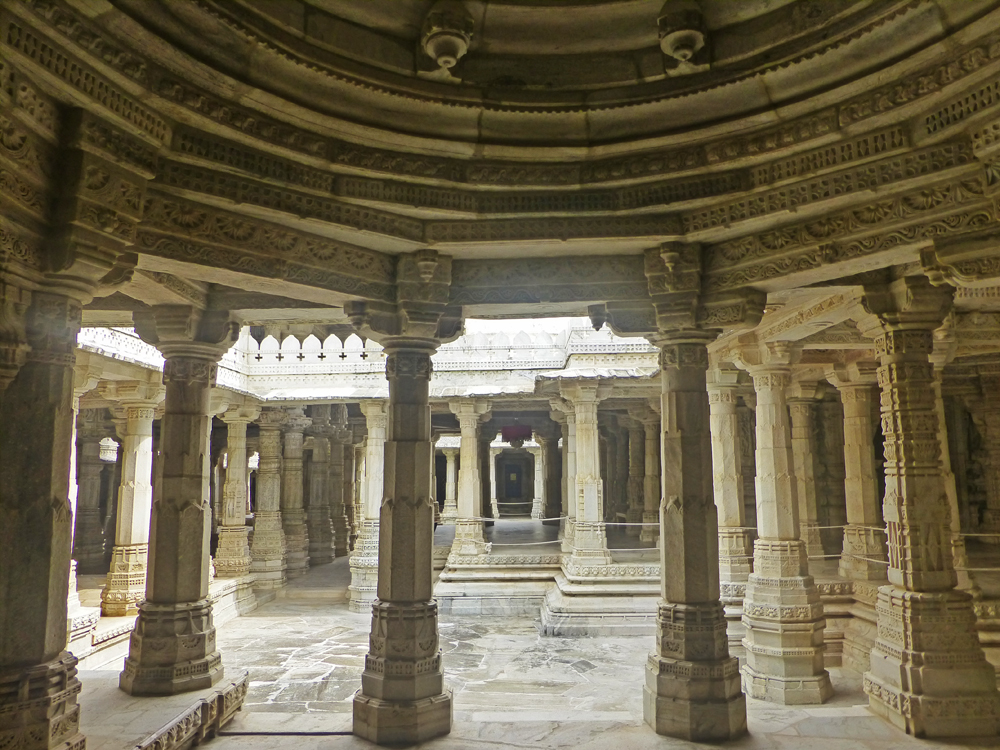
However, what we saw inside was really, really (really) special! Words cannot do the temple justice, but it can only be described as “a veritable forest of intricately carved white marble pillars interspersed with equally elaborate domed ceilings and the occasional marble elephant” (copyright Monique Z, 2013). It is really one of the most spectacular man-made things I have ever seen, and gives Ankor Wat a run for its money. I must have walked around the temple 10 times, and each time I walked into an area from a slightly different angle it was like I was seeing it for the first time; all of the solid marble pillars, walls and ceilings feature unique carvings, and hours could easily be lost discovering new features. The head priest took an interest in us and showed us around, pointing out a number of the most elaborate carvings and some interesting features. One interesting thing about Jain temples is that the Jains consider that only god is perfect, and consequently they deliberately make each temple flawed; in this case the flaw took the form of one very slightly crooked pillar.

Anyway, enough words, and on to the pictures:


After tearing ourselves away, we also visited a couple of other nearby temples. In any other company those other temples would have been considered spectacular, and the carvings are as good as any we had previously seen on this trip, but unfortunately for them they just paled in comparison to their big brother next door.

The local monkeys, however, seemed to prefer to hangout at these smaller temples. They also seemed to enjoy intimidating tourists by jumping out of trees and charging at them, grabbing at loose clothing as they pass. One of them also seemed to enjoy riding a stone lion on top of the temple.


Somewhat dazed by the truly spectacular things we had seen, we made our way back to Udaipur, collected our bags and made our way to the bus station for an overnight train to Agra. After this day-trip it looks like the Taj Mahal has some extremely stiff competition for the most impressive building in India!