Wednesday, February 12, 2014

Spelunking in Sagada

The journey from Coron to Sagada was a long one. A really long one. We flew into Manilla early, made our way straight to the bus station, took a long bus journey to Baguio where we stayed overnight before taking another long bus journey to Sagada the following day. Fortunately the bus journeys passed relatively quickly as the scenery kept getting better and better the further north we went (although difficult to capture from the moving bus).


Sagada is a teeny tiny town in the mountain province of Luzon. I knew as soon as we arrived that I was going to like it; the weather was good, the air was fresh and the view from our balcony wasn't bad either.


The town is so small that just a few minutes' walk from our guesthouse took us into the stunning surrounding countryside.


For Monique, the highlight of Sagada was right next door to our guesthouse where the family's pet dog had recently had a litter of adorable puppies. Monique wasted no time in heading down to make friends with the puppies, and thereafter visited them at least a couple of times a day to check on them and play with them. Monique made a particularly strong bond with the runt of the litter whom she named Runty Rascal and who, after initially being a bit scared of us, started to come scrambling up the steps when Monique called him. Put it this way: I felt the need to check Monique's backpack when we were leaving Sagada to make sure that Runty Rascal wasn't joining us for the remainder of our trip!


Despite being so remote Sagada is popular with tourists for a couple of reasons, both of which we experienced on our second day there. We arranged to take a caving trip; for reasons that would soon become clear it is essential to take a guide into the caves. Our guide's first words to us were “So what made you decide to come to Sagada to die?”. On the assumption that this was a joke we followed him to the caves that are just 10 minutes walk from the town. On the way to the cave that we would be exploring our guide took us to a different cave entrance where we were met by this sight:
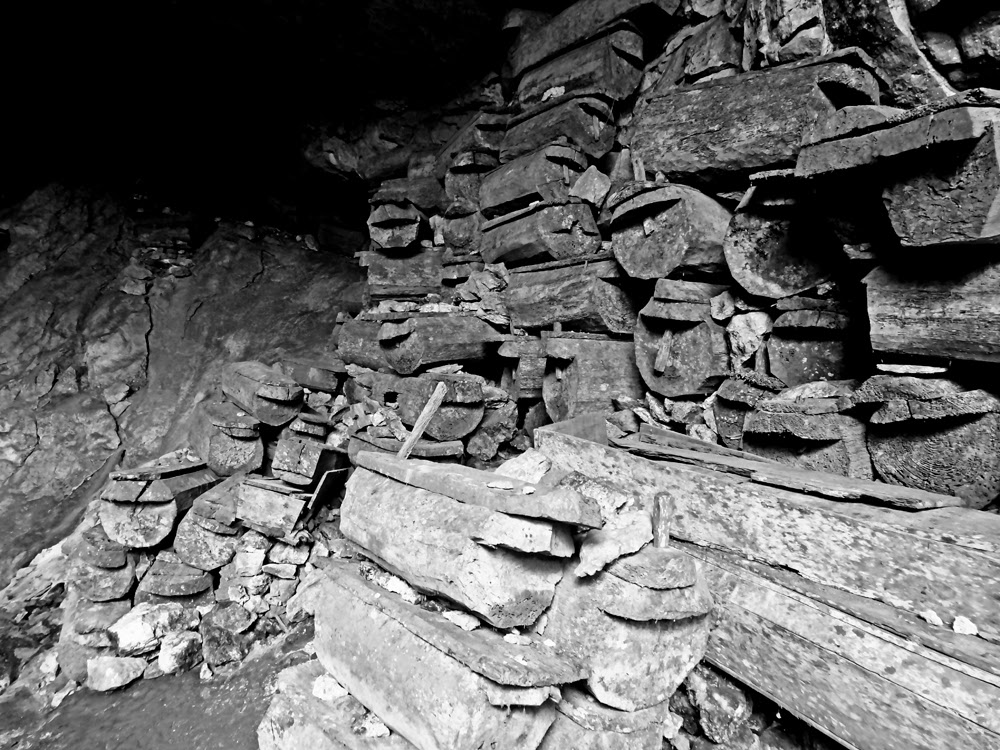


In Sagada it is a tradition that when certain people die, instead of being buried or cremated, they are placed in coffins which are either hung from cliff-faces or placed in the mouth of a cave. The tradition continues to the present day. The sight which met us was numerous real coffins stacked up on top of each other over and around the mouth of the cave. It was completely surreal. It was possible to see into some of the coffins and see the bones inside.


The coffins are small because it is also traditional for the deceased to be placed in the fetal position as they were before they entered the world. It's certainly an interesting way of treating people after they pass, and another example of how Asian countries seem to have a more healthy attitude to death than Western countries where death is a bit of a taboo subject (the other most striking example on this trip being India where the dead are cremated in elaborate public ceremonies). Just in case there was any doubt, a sign let us know what type of conduct was unacceptable.


We also saw some more coffins on the way to the cave.


We then made our way to the cave entrance which we would be entering. The first part of the cave was an extremely slippery descent down treacherously smooth and wet rock. Our guide lit the way using a gas powered lamp which was surprisingly effective at lighting up the otherwise pitch-black cave, and also made for a cool photo of him when we took a rest break.


After we had carefully negotiated the slippery descent the rock completely changed to a sandpaper-type texture. The cave we were exploring is part of a long cave system, but we were only going part way before looping back on ourselves. This meant that we were able to take off our footwear, leave them for us to collect later, and continue barefoot which allowed us to take full advantage of the high friction of the rough rock. After having to be so careful with every step to not slip over it took some time to gain confidence in our footing, but the sandpaper-type surface meant that our feet almost stuck to the rock on landing. This proved to be extremely useful as our tour was about to get a little more extreme.


What followed was more like an obstacle course than a guided tour. We balanced across narrow strips of rock, jumped across water-filled holes (the water wasn't that deep, but it sure was cold so I was keen to avoid taking a bath) and scampered on all fours down steep slopes with freezing cold water gushing down them (no chance of staying dry this time. We appeared to have reached the end of the accessible portion of the cave when the cave floor turned into a vertical drop; however our guide had different ideas and showed us how easy it was to lower yourself down in between two parallel sections of rock wall about 3 feet apart from one another. I have since learned that this technique is called chimneying. I'm not quite sure what I did but it was very different to what the guide did, and was definitely not a great example of chimneying, but I did safely lower myself down the 15 foot high drop. Monique followed in much more graceful fashion.


Virtually any cave tour in any country will involve a section where the guide asks you what you think certain mineral formations look like. Every single time I have played this game I have had to bite my tongue and try not to say the purile thoughts that immediately spring to my mind. This tour was no different, except that this time the purile thoughts that immediately sprang to my mind were the correct answers. Highlights included the King's Jewel's and the Queen's Jewels. Photographs of these...erm...remarkable structures do exist (courtesy of our guide who took it upon himself to take photos using our camera when we declined to do so), but I will save you from them. Instead you'll have to settle for the much more savoury “birthday cake” formation.


After exploring the deepest part of the cave for a while we took a different route back up. At one point our guide balanced precariously with one hand braced against an overhead ledge whilst hauling us up with his other hand. Filipino men may be small and skinny but they are much stronger than they look! At another point we pulled ourselves up a steep slope using a knotted rope. This is a good example of how “sticky” the rock surface was.


It was a really remarkable tour, and one which would NEVER be allowed in any country in Europe or North America. In fact, there are plenty of other Asian countries where they would draw the line before letting inexperienced tourists do that sort of caving. Apparently the extended tour through the cave system is even more extreme and involves crawling through extremely small passageways and swimming through the icy water. Apparently it used to include a section where you had to lower yourself down a rock face using a rope before pushing yourself out and swinging across a long drop to the ledge on the other side, but this is no longer part of the tour because too many people died doing it (NB: that's right “too many” people died, not one or two people, but “too many”!) I wasn't tempted by the full cave connection tour as it sounded a bit claustrophobic for my liking, but Monique was keen on doing it the following day until she woke up with a variety of aches and pains from our tour and decided against it.

As we rested after exiting the cave Monique befriended yet another local puppy.


The following day we took a walk to the nearby Echo Valley. The valley itself was fairly picturesque, and does indeed have an echo, but the purpose for going there was to see some more hanging coffins. Once again, it was a surreal experience, not least because this time the coffins were inexplicably joined by some hanging chairs (were they expecting guests?!). That said, I quite like the idea of being left somewhere with a nice view and a fresh breeze when my time comes.


 Apart from our caving trip Sagada was a really peaceful stop. However, even in the most peaceful of places we are extremely capable of creating drama and Sagada was no exception. We were aware that Sagada had only one ATM and that it is not always open, however what we didn't anticipate was that when it is open it does not accept foreign cards. We were left without enough cash to pay our guesthouse bill and so we had to take a jeepney to Bontoc, a larger city about an hour's drive away, where on the third attempt we were able to take some money out. The upside of this was that we discovered that Bontoc has an extensive range of extremely cheap DVDs (which may or may not be legit), and so we stocked up on a few tv series to catch up on once we arrived the US.

We thoroughly enjoyed our stay in Sagada. It is a place where I could happily have stayed for longer just chilling out on our balcony and enjoying the views and pleasant climate. We also had some really great food there, thanks in part to the climate being suitable for growing a range of fresh vegetables. Unfortunately we had to get back to Manilla in time for our flight to Hong Kong (although we had been able to put our flight back by a few days after our original flight was cancelled) and we were keen to fit in one more stop before leaving the Philippines.

Tuesday, February 11, 2014

Wreck-Diving in Coron

An 8 hour journey in a small boat sat on hard wooden benches benches wasn't the ideal way to spend the majority of my birthday but we were both relieved to be moving again after spending far too long in El Nido and the scenery wasn't too shabby.


Our arrival in Coron wasn't ideal either. The first guesthouse we checked into, which was highly recommended, turned out to have bed-bugs; fortunately we found our more-or-less immediately and left before we were bitten and our clothes contaminated. We then wandered around the town for a while trying to find somewhere suitable to stay; however everywhere we looked at was far too expensive. We resorted to enlisting the help of a tricycle driver, but that only resulted in an argument after he took us to a guesthouse which was full and they tried to charge us twice the price we had agreed for the journey. Just as we were about to give up and pay well over the odds we came across a brand new guesthouse that was still unfinished, but which was friendly, sparklingly clean, and cheap as chips. The day was rescued by a really nice meal and a well needed beer at a restaurant with a sea view and decorated with mermaids, rounded off by a birthday crepe and a rendition of Happy Birthday by the waitresses.


We spent a day exploring the town which was pretty nice without being especially interesting. Coron is pretty small and quiet, but after Sabang and El Nido it was actually really nice to be in a real town with proper roads again. It has a busy market and an even busier harbour which is mostly used by tourist boats running day trips and diving tours. It looks like the Coron tourism board have taken a few tips from some other major cities (either that or they've played too much Sim City). Firstly Coron has its own Hollywood-style sign on the side of one of the town's hills.


Secondly the huge cross on top of the largest peak which overlooks the town, Mount Tapyas, must be the Coron equivalent of Rio's Christ the Redeemer. We made short walk up to the top of Mount Tapyas that evening to enjoy the views just before sunset and were fortunate enough to see a gorgeous double rainbow while we were up there.


The following day was the main purpose for our visit to Coron. From 21st to 24th September 1944 15 Japanese were ships were sunk by a series of US airstrikes whilst at anchor in Coron Bay and around the nearby Busuanga Island (anyone interested in a brief history lesson can look here). The most significant result of this was its contribution to the liberation of the Philippines from the Japanese, but for our purposes the result was that a number of the shipwrecks are accessible to scuba divers. The combination of scuba diving with WWII shipwrecks sounded almost too good to be true, but turned out to be even better than we had expected.

The diving experience was hugely different to what we had experienced in Gili Air. For starters, we were kitted out in thick full-body suits rather than the short sleeved/legged suits we had worn before. More importantly instead of sharing a boat with 15+ other divers we had an entire boat to ourselves (well, ourselves, the boat crew, an instructor for Monique and a local guide for me). It felt completely indulgent. They had obviously heard that I had recently turned 32 as they had prepared a seat especially for me.


I was already excited enough, but my excitement went up a notch when my guide showed me a plan of the first wreck we were going to explore – the East Tungat anti-submarine boat - and informed me that we were actually going to swim through the wreck. I headed straight down to the wreck while Monique first did some training. Fortunately Monique's instructor was a really chilled out and patient guy so this time around Monique had no problems whatsoever and was able to dive down to the wreck shortly afterwards. It was an incredible experience! The visibility wasn't great so the ship appeared mysteriously once we got a few metres away. The East Tungat is 35m in length, completely covered in coral, plants and algae and surrounded by fantastic tropical fish – I've never seen anything like it. We were able to swim right into the ship and, with a little assistance from our guides, could see a few details including where the kitchen and sleeping quarters were. It was much more technical diving than I had done before because it was essential to control your depth in order to move through the wreck without hitting the ship, and made me a little nervous at first, but it didn't prevent either of us from enjoying the unique sight around us.


The next wreck was the Olympia Maru – a much larger 127m long cargo ship. Because of the depth of this wreck Monique wasn't able to dive down to it, and I could only go down to the level of the deck and couldn't go inside it. It was one of the single most amazing things I've ever seen! The ship was absolutely huge and was covered in so much coral that it was easy to temporarily forget that I was looking at a man-made object rather than the sea floor when swimming over flat areas of the deck. The ship has eight huge chimneys which towered spectacularly above me and made me feel tiny. One of the downsides of travelling for an extended period of time is that you see and experience so many amazing things that you start to take them in your stride and maybe don't appreciate them as much as you should at the time. Periodically, however, I have memorable moments where I take a step back and the reality of what I'm doing hits me; this was very much one of those moments. The combination of scuba diving (which I wasn't really sure I'd ever do and which is a fantastic experience in of itself), amongst fantastic sealife and around a genuine World War II shipwreck was an unforgettable experience. As fantastic as the ship itself was, the highlight of the Olympia Maru was probably when I was checking out the gun turret at the front of the ship and saw a huge lionfish swimming not far below me.  I descended a few metres (probably going a bit deeper than I was strictly allowed to) to find that the side of the ship was covered in dense hard coral, and that in and around the coral there must have been about 30 lionfish plus an awesome crocodile fish who were all happy to continue relaxing despite my presence.  It was a truly amazing sight!

The final stop was the Lusong Gunboat which we were both able to explore. The Gunboat was much smaller and shallower than the others, which meant that it had the advantage of it being lighter.  It was therefore easier to spot some of the smaller and more stationary sealife such as urchins, sponges and sea cucumbers, as well as the creatures which tend to hide from plain view including the comical jawfish whose bulbous eyes tend to give it away. Monique was even able to let a shrimp clean her fingers until it started to tickle too much for her to be able to keep still. Due to the shallow depth we were able to explore all around and through the boat, which involved squeezing through some pretty tight spaces (and resulted in a grazed ear for me). It was another fantastic experience.

It's really impossible to put into words how great the day was. There are loads of videos online of wreckdiving around Coron, but I have yet to find a one that gives a good idea of what we saw. However, these two short promotional videos do give a decent idea of the experience generally.


This video does a great job of showing the type of sealife we saw around the wrecks, although we weren't lucky enough to see a turtle or a squid:


It was pretty much impossible to top our day of wreckdiving, but before we left Coron we took great boat trip. The weather wasn't great, but that didn't stop us from having a good time.  First we stopped at a beautiful fresh water lagoon high up on an island where we swam, explored the caves and played with the needle fish (who, rather grossly, enjoyed eating my skin that was peeling after getting sunburned).


After that we did some fantastic snorkelling with some of the most impressive coral to date and a huge range of tropical fish. We then stopped at a beach for lunch cooked by our guides, before another lagoon and another snorkelling stop. It was yet another fantastic day.


We also took an evening trip out to the natural springs just outside of Coron. The journey was not very relaxing as it involved incredibly bumpy “roads” and we had to get out on more than one occasion to enable our tricycle to get up some steep slopes. However, that made our soak in the hot spring all the more relaxing.

Unfortunately all good things must come to an end, and the time came to leave Coron and the Palawan area. As with any flight we were anxious to get to the airport in a timely manner, and were aware of potential delays. We were relieved then to discover that the only “traffic” which slowed down our bus journey to the airport was a herd of goats, and that the airport itself is little more than a barn with a handful of security personnel (who appeared most concerned with preventing people from taking shells with them) and a field behind it with an area of tarmac which sufficed for a runway. In hindsight, after spending quite a while in this sleepy part of the world I'm not sure why I expected anything else.


Thursday, January 30, 2014

El Nidooooooooooooooooooooo

Our next stop was El Nido at the very north of Palawan where we would end up staying for longer than anticipated. The journey to El Nido wasn't the most comfortable; first we took a bus from Sabang which chucked us out when it reached the nearest major road junction, from where we were lucky to get the last two available seats in a mini-bus with our luggage crammed right behind us.  We checked into a guesthouse which was essentially the upstairs floor of a family home, complete with four dogs. The major selling point was a large balcony overlooking the beach, although by the time we had checked in it was too dark to see the view. The view that greeted us the following morning was pretty spectacular. El Nido is spread along a narrow crescent-shaped beach. Beyond the beach and the numerous boats in the natural harbour were dramatic limestone cliffs jutting out of the water, reminiscent for us of Halong Bay inVietnam.


Unfortunately, the weather still wasn't co-operating with our plans to enjoy the plethora of beautiful beaches nearby. Almost the whole time we were in El Nido (which was a looooong time) it was mostly overcast with spells of high winds and rain. The occasional periods of sunshine were unpredictable and rarely lasted long enough to take advantage of them. Still, things could have been worse – we had a comfortable balcony from where we could read our books, listen to music and enjoy the view (that is when we didn't have to pull the covers down for protection from the elements), and the beach-side bars had a variety of happy-hour offers that were so good they were difficult to turn down.

So far in the Philippines the food had been underwhelming. It wasn't that it was bad, it was just that there wasn't much in the way of traditional Filipino food, and most places offered a variety of generic fried rice/noodle dishes alongside Western dishes like pizza, pasta and burgers. The Filipino food that was offered mostly consisted of fried chicken, fried rice and a fried egg; not particularly inspired. A number of the recommended restaurants in El Nido were closed during the low season, but we did find a couple of places that served really good food, and we ended up frequenting those places regularly over the coming days. Alcohol, on the other hand, was not problematic in the slightest – in fact in the Philippines it is so cheap that it is genuinely difficult to decline it. A bottle of San Miguel is cheaper than a can of coke, and only slightly more expensive than a bottle of water. Throughout the trip I had only occasionally had a beer as a treat, and usually opted for water which was much more sensible in the hot weather; here I figured that beer had plenty of water in it anyway, so it was the best of both worlds!

Whilst the town itself was very pleasant (well, at least it would be in decent weather) we had come to El Nido to enjoy the beauty of the local area. The best way to explore the area is by way of a number of all-day boat trips. The really nice thing was that instead of countless places offering all sorts of different tours at different prices that are next to impossible to compare, in El Nido there are 6 set tours, A to F, at set prices. This greatly reduced the amount of time we had to spend shopping around and deciding what to do and through which tour company. Instead we were faced with a different difficulty, as the weather was preventing boat tours from leaving every day like usual. Instead, after we opted for a particular tour we had to wait until the following morning to see if the weather was calm enough for us to go.

Thankfully, after one day written off due to the weather it cleared up enough the following day for our tour to leave. The tour took us through the spectacular limestone landscape and made a number of stops at various points:

Firstly we stopped at the beautiful Commander beach on a tiny island.


Unfortunately as the morning progressed, the weather deteriorated and it got colder and colder on the boat, and it became impossible to get dry and warm after swimming due to the rain. It actually had potential to get quite miserable, however our guides were so relentlessly chipper that it was impossible not to have a good time. The rougher the sea, and the colder and wetter they got the happier they seemed to be.

The highlights of the day were two spectacular lagoons aptly named the Big Lagoon and the Small Lagoon. The Big Lagoon was accessible only by two of the guides getting into the water to guide the boat through a narrow passageway in between the rocks (which, of course, they did with huge smiles on their faces) before swimming in through an entrance too narrow for boats. The Small Lagoon was even more secluded, as the only way in was by swimming under the rock through an extremely narrow entrance. Once inside the Small Lagoon opens up into two sections (is isn't actually that small), and also has a really cool water-filled cave with a natural skylight at the top of the cliff above you. Both lagoons were absolutely stunning – floating in the beautiful crystal clear emerald coloured water whilst looking up at the huge limestone cliffs that completely surrounded us felt like we were some sort of different world.

Next stop was the beautiful and rugged Shimizu island where we did some great snorkelling and then ate a lunch of barbequed sea-food and fresh fruit prepared by our guides.


Shimizu island is also home to hundreds of tiny hermit crabs.


After lunch we headed out a little to a fantastic snorkelling spot where we saw all kinds of tropical fish and fantastic coral. Fortunately the bad weather had just held off for us to eat lunch, and of course it doesn't matter if it's raining while you're snorkelling, but the wind and rain started to really pick up and the water became quite choppy so we headed back onto the boat before it turned into a full-blown storm.

The next stop was supposed to be the Secret Lagoon; however, by the time we made it back onto the boat the weather had turned really nasty, and to go to the Secret Lagoon would have meant us heading straight into the storm (which looked like a solid block of greyness). Our guides gave us the option of continuing, but the decision was unanimous that we should give the Secret Lagoon a miss. Instead we went in the opposite direction to another tiny island which provides a nice look-out point over the interesting sand ridge which has formed due to two conflicting currents meeting, and which means that you can walk from one island to the next.

Despite the weather being awful for a large part of the day, and forcing us to miss the Secret Lagoon, we had a terrific day. We were cold and wet most of the time we were on the boat, but the water was fairly warm (apart from in the lagoons) and the sights we saw and the relentless cheeriness of our guides more than made up for the weather.

In fact we enjoyed the tour so much that we signed up for a different tour, which was able to leave a couple of days later. We started off on a fantastic beach where Survivor was apparently filmed a few years ago. The main focus of the tour was snorkelling, and we made two extended stops for that purpose. The first stop didn't look promising at all, as the water stayed extremely shallow for a long distance from the shore, and in fact the others on the tour didn't actually bother going into the water; however, once we got out far enough the sea-floor dropped dramatically, and the shelf had some great coral and a fantastic selection of fish. The second snorkelling stop was even better; in fact it had some of the best coral we had ever seen – including huge flat corals which must have measured 4m across – and an incredible range of tropical fish including plenty of varieties that we had not previously seen on the trip. Apart from the absence of turtles the quality of the marine life was at least as good as what we had seen in Indonesia.

In between snorkelling stops we ate lunch (again, barbequed seafood cooked by our guides) on a lovely island which also had a small cave which could be explored by scrambling through a small hole. It was another great day.

After a few days we were ready to move on from El Nido. As beautiful as the area is there is only so much time one can stay at the beach when the weather isn't co-operating, and we were running out of boat tours to do. Our next intended destination was Coron Island; however there is only one boat scheduled per day to make the 8 hour trip from El Nido to Coron and due to the bad weather there was no guarantee when it would be able to leave. I honestly don't know how many days we waited for that boat as many of the days in El Nido blend into one. Every day the owner of our guesthouse would tell us that the boat would hopefully leave the following day, only to subsequently inform us that it had been cancelled. It was really frustrating.

Our stay in El Nido was by far our longest stay anywhere (with the exception of Hydrabad). We tried to make the most of the additional time in El Nido - if it wasn't for this delay we probably wouldn't have gone on a second boat trip, and it did give us longer to catch up on some reading and blog writing (when we had electricity) and to take advantage of the aforementioned happy hours. When the weather was temporarily nice one day we took a tricycle to a different, quieter, beach which we enjoyed for a couple of hours until the clouds and rain returned. We also investigated a range of alternative options including heading back South to Puerto Princessa and flying to a different part of the Philippines from there; however we really wanted to go to Coron (for reasons that will be abundantly apparent in the next blog post) and in any event there didn't seem to be anywhere else in the Philippines where the weather was any better, so we decided to wait it out.

Eventually, about 8 or 9 days after arriving in El Nido, and about 4 days after we had planned to leave, we got the go ahead that a boat was leaving for Coron on 30th September – my birthday. Happy birthday to me!